
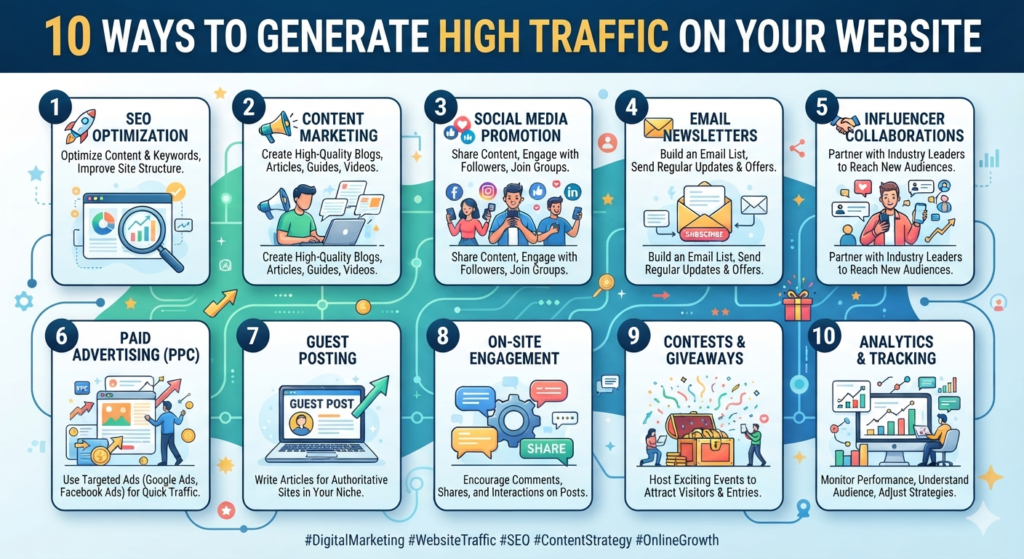
Type your paragraph here1. Search Engine Optimization (SEO)Search Engine Optimization is the foundation of sustainable, long-term website traffic. When users search for topics related to your industry on Google, you want your website to appear on the first page.Keyword Research: Identify high-volume, low-competition keywords using tools like Google Keyword Planner or Ahrefs. Target long-tail keywords (e.g., "best organic skincare for dry skin") as they have clearer user intent.On-Page SEO: Optimize your title tags, meta descriptions, headers (H1, H2), and image alt text with your target keywords. Ensure your content directly answers the user's search query.Technical SEO: Improve your site structure. Clean up broken links, ensure your website loads fast, and make sure it is fully responsive on mobile devices.
2. Strategic Content MarketingContent is the magnet that pulls visitors to your site. High-quality, valuable content positions your brand as an authority and gives people a reason to return.Diverse Formats: Don't limit yourself to text. Create a mix of detailed blog posts, step-by-step guides, infographics, case studies, and video content.Consistency: Establish a regular publishing schedule. Search engines reward active websites, and audiences appreciate predictability.The Evergreen Approach: Write comprehensive "evergreen" articles that remain relevant over time. These pieces continue to accumulate organic traffic months or years after publication.
3. Social Media PromotionSocial media platforms are massive discovery engines. You cannot rely solely on people finding you through Google; you must actively put your content where your audience spends their time.Platform Matching: Choose platforms that match your demographic. Visual brands thrive on Instagram and Pinterest, professionals connect on LinkedIn, and dynamic discussions happen on X (Twitter) or Threads.Active Engagement: Do not just drop links. Engage in the comments, ask questions, join relevant niche groups, and participate in community discussions to build trust before asking users to click away to your site.
4. Email Marketing and NewslettersWhile other channels rely on third-party algorithms, your email list is a traffic source you own entirely. Email marketing keeps your existing audience engaged and pulls them back to your site regularly.Lead Magnets: Build your list by offering a free resource—like an ebook, a checklist, or a discount code—in exchange for an email address.Segmented Updates: Send regular, well-formatted newsletters highlighting your latest blog posts, product launches, or exclusive insights. Segment your list to ensure users only receive content tailored to their specific interests.
5. Influencer CollaborationsPartnering with influencers allows you to instantly tap into an established, trusting audience that aligns perfectly with your target market.Micro-Influencers: Look for creators with 5,000 to 50,000 highly engaged followers. Their audiences are often more loyal and interactive than those of massive celebrities.Co-Created Content: Collaborate on guest reviews, social media takeovers, or joint webinars that naturally direct their followers back to a dedicated landing page on your website.
6. Paid Advertising (PPC)If you need immediate results while waiting for organic strategies to mature, Pay-Per-Click (PPC) advertising is the fastest route to high traffic.Search Ads: Use Google Ads to target users at the exact moment they search for specific buyer-intent keywords.Social Ads: Utilize Meta Ads (Facebook/Instagram) or LinkedIn Ads to target highly specific demographics based on interests, behaviors, age, and job titles. Start with a small budget, A/B test your ad copy, and scale what works.7. Strategic Guest PostingGuest posting involves writing high-quality articles for other established websites in your industry. This strategy boosts your traffic in two distinct ways.Referral Traffic: Readers who enjoy your guest post will click the author bio link to explore your website.Backlink Building: Search engines view links from authoritative sites as a vote of confidence. Accumulating high-quality backlinks significantly elevates your overall domain authority and organic SEO rankings
.8. Enhancing On-Site EngagementGenerating traffic is only half the battle; you must also keep visitors on your site once they arrive. High bounce rates signal to search engines that your site lacks value.Internal Linking: Weave relevant internal links throughout your content to guide users seamlessly to other articles or product pages on your site.Interactive Features: Encourage community interaction by enabling a vibrant comment section, integrating social sharing buttons, and adding related-posts widgets at the bottom of every page
.9. Contests and GiveawaysPeople love free things, making viral giveaways an incredibly effective tool for rapid traffic spikes and brand awareness.Entry Requirements: Host a contest where users must visit a specific landing page, subscribe to your newsletter, or share a link on social media to enter.Relevant Prizes: Ensure the prize appeals directly to your ideal audience. Giving away a generic tablet will bring low-quality traffic, while giving away your specialized product or service brings highly qualified leads.
10. Analytics and Data TrackingYou cannot improve what you do not measure. To sustain high traffic, you must analyze your data to understand exactly what drives performance.Google Analytics: Use data tracking tools to monitor vital metrics such as total visitors, page views, average session duration, and top referral sources.Strategy Adjustments: Identify which blog posts perform best and create more content around those topics. Conversely, locate pages with high drop-off rates and optimize them to patch your traffic leaks.
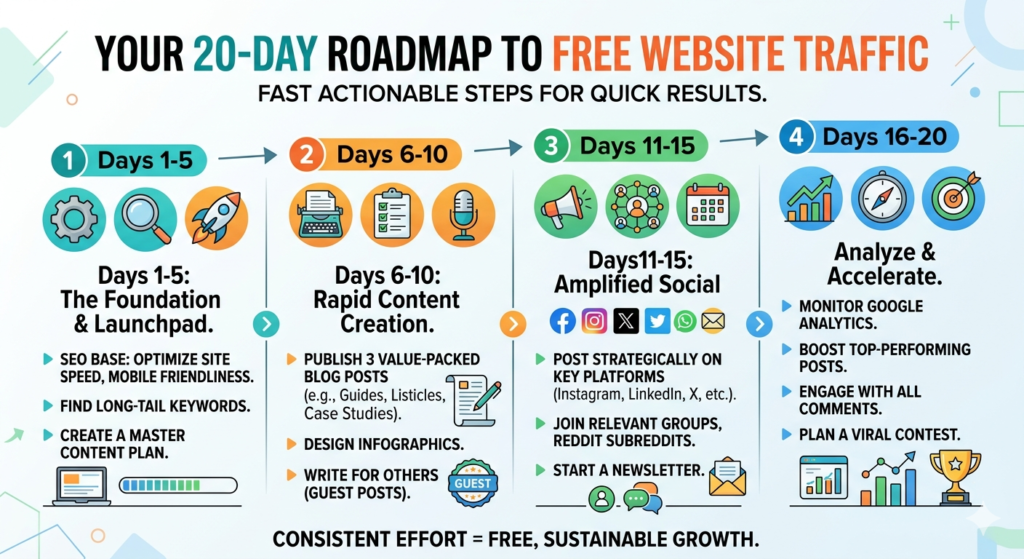
20 Days or Less: The Ultimate Roadmap to Generating Free Website TrafficLaunching a website or trying to revive a stagnant blog can feel incredibly discouraging when nobody is visiting. Most traditional digital marketing guides will tell you that Search Engine Optimization (SEO) takes four to six months to show any real results. While long-term SEO is absolutely critical, you do not have to wait half a year just to see your first wave of visitors.If you need a sudden, powerful influx of visitors without spending a single dollar on ads, you need a hyper-focused, aggressive strategy. This 1000-word blueprint provides a day-by-day action plan to generate free website traffic within 20 days or less.
Days 1–5: The Technical Foundation & Content LaunchpadYou cannot drive traffic to a broken or empty website. The first five days are entirely dedicated to prepping your digital house so that when visitors arrive, they actually stick around.Step 1: Maximize Site Load SpeedGoogle explicitly penalizes slow-loading websites, and human visitors have even less patience. Use free tools like Google PageSpeed Insights or GTmetrix to test your site. Compress large images, remove unnecessary design widgets, and clear out bloated plugins. Aim for a load time under 2.5 seconds.
Step 2: Ruthless Long-Tail Keyword ResearchForget about ranking for hyper-competitive, single-word phrases like "fitness" or "finance" within 20 days. Instead, target highly specific long-tail keywords with low search difficulty but clear user intent. Look for phrases like "keto meal prep plan for busy beginners" or "affordable sustainable graphic design tools." Use free tiers of tools like AnswerThePublic, Ubersuggest, or Google Keyword Planner to find these hidden phrases.
Step 3: Map Out Your 20-Day Content MatrixCreate a rapid content production schedule. You will need to write and publish highly valuable, highly readable content over the next week. Identify the top 5 urgent questions your target audience is asking online right now, and prepare to answer them completely.
Days 6–10: Rapid High-Value Content CreationContent is the fuel for your traffic engine. During this phase, your sole focus is to create magnetic assets that give people a compelling reason to click on your links.
Step 1: Write Three "10x" Core Blog PostsPublish three exceptionally detailed articles that are ten times better than whatever currently ranks on the first page of Google for your target long-tail keywords.Format for Skimmers: Use short paragraphs (under 3 sentences), heavy bulleting, bold fonts for emphasis, and clear subheadings (H2 and H3 tags).Actionable Depth: Don't just explain what a problem is; give a step-by-step tutorial on how to solve it. Aim for 1,500 to 2,000 words per post.
Step 2: Design Micro-InfographicsVisual content gets shared significantly more than plain text. Take the core data or steps from your new blog posts and turn them into simple, scannable infographics using free design templates on Canva.
Step 3: Secure One High-Impact Guest PostIdentify a mid-tier blogger or website within your niche that already has an active readership. Reach out via email or social media and offer to write a comprehensive, free article for their platform. In exchange, include a natural link back to one of your newly created core blog posts within the article body or your author biography.
Days 11–15: The Amplified Social PushNow that your high-quality content is live on your website, it is time to manually pull people in. Do not just drop a link on your personal profile and hope for the best; you must go where your communities gather.
Step 1: Platform-Specific Micro-BloggingDo not simply post "Hey, I wrote a new blog post, check it out!" That yields zero engagement. Instead, copy a highly valuable excerpt or checklist from your article and post it directly onto platforms like LinkedIn, Instagram, or X (Twitter) as a standalone text thread or carousel image. At the very end of your highly engaging post, drop a call-to-action: "For the complete, step-by-step breakdown with free templates, check the link in the comments below."
Step 2: Ethically Infiltrate Reddit and QuoraSearch for subreddits and Quora threads that match your exact industry niche. Look for active discussions where users are complaining about a specific problem that your blog post solves.The Value-First Rule: Write a detailed, helpful, and compassionate response directly in the forum thread to solve their problem.The Soft Pitch: Drop your website link at the end only as a supplementary reference for further reading. If you spam links without providing upfront value, you will be permanently banned immediately.
Step 3: Launch a Bare-Bones Newsletter Lead MagnetPut a simple, non-intrusive email subscription pop-up on your website. Offer a free, instant-download checklist or a mini PDF guide in exchange for their email address. Capturing your early visitors via email ensures you can repeatedly pull them back to your site for free whenever you post in the future.
Days 16–20: Analyze, Patch, and AccelerateThe final five days are about diving deep into your data, figuring out what worked over the last two weeks, and doubling down on those specific wins to lock in steady traffic growth.
Step 1: Decode Your Google AnalyticsLog into Google Analytics or Google Search Console to evaluate your traffic sources.Identify which specific social media platform or community link drove the highest number of clicks.Check your average session duration. If users are leaving your site within 10 seconds, your formatting is unappealing or your intro paragraph isn't hooking them. Fix it immediately.
Step 2: Repurpose Your Top-Performing AssetTake the single most successful blog post or social media thread from the past 15 days and transform its format. If it was a text post, turn it into a short-form video (TikTok, Instagram Reel, or YouTube Short). Pin this video to the top of your profiles with a clear link pointing straight back to your website.
Step 3: Engage with Every Single CommentAnswer every single comment, reply, direct message, or email you received during this 20-day sprint. Building strong, individual relationships with your earliest visitors converts casual clickers into loyal brand advocates who will naturally share your site with their own networks.

1. Define Clear, Measurable GoalsBefore you create a single post or design a graphic, you must understand exactly what you are trying to achieve. Without goals, you cannot measure success.The SMART Framework: Ensure your objectives are Specific, Measurable, Achievable, Relevant, and Time-bound. Instead of saying, "I want to grow my Instagram," set a goal like, "I want to increase our Instagram referral traffic by 25% over the next quarter."Align with Business Objectives: Your social media goals should mirror your overall business needs. If you are launching a new product, focus on brand awareness and reach. If you want to scale sales, focus on click-through rates (CTR) and conversion tracking.
2. Research and Understand Your Target AudienceA common trap in social media marketing is attempting to speak to everyone. When you try to appeal to everyone, you end up appealing to no one.Create Audience Personas: Build detailed profiles of your ideal customers. Document their demographics (age, location, occupation), pain points, interests, and online habits.Platform Selection: Different demographics flock to different platforms. Gen Z dominates TikTok and Instagram, professionals congregate on LinkedIn, and visual shoppers heavily utilize Pinterest. Put your time and resources only where your specific audience actively spends their hours.
3. Master the Content Matrix (The 80/20 Rule)Social media users do not log on to view continuous advertisements. To keep your audience engaged, you must provide consistent, diverse value.The 80/20 Rule: Dedicate 80% of your content to educating, entertaining, or informing your audience. Save only 20% of your posts for direct promotional offers and product pitches.Content Formats: Mix up your delivery styles. Use short-form vertical video (Reels, TikToks, Shorts) for rapid discovery, carousel posts for educational breakdowns, and live streams to build deep, real-time trust with your community.
4. Build and Maintain a Strategic Content CalendarConsistency is the foundational currency of all social media algorithms. If you post heavily for three days and then disappear for two weeks, your visibility will plummet.Batch Production: Dedicate a specific day each week to writing captions, filming video content, and designing graphics. This stops the daily panic of wondering what to publish.Scheduling Tools: Use management platforms like Buffer, Hootsuite, or Later to schedule your posts ahead of time. This ensures your content goes live at the optimal hours when your target audience is most active online, regardless of your time zone.
5. Prioritize Community Engagement Over BroadcastingSocial media is designed to be interactive. The algorithms heavily favor profiles that actively spark conversations and build community spaces.The First-Hour Rule: Spend the first 30 minutes after publishing a post actively replying to early comments. This signals high engagement to the algorithm, prompting it to push your post to a broader audience.Proactive Outreach: Do not just wait for people to come to you. Leave genuine, helpful comments on other industry accounts, answer questions in community groups, and regularly interact with your followers' content to establish an accessible, human presence.
6. Leverage the Power of Micro-InfluencersWord-of-mouth marketing remains highly effective, and influencer partnerships act as digital word-of-mouth at a massive scale.Target Engagement, Not Follower Counts: Instead of chasing massive celebrities with millions of superficial followers, partner with micro-influencers (10,000 to 50,000 followers). Their audiences are typically niche-specific, deeply loyal, and highly interactive.Authentic Integrations: Allow creators the creative freedom to showcase your product or service in their own unique voice. Audiences can spot forced, corporate scripts instantly, which completely destroys campaign credibility.
7. Master Paid Social Media AdvertisingWhile organic reach is excellent for building a long-term community, paid social advertising is the fastest route to scale your visibility and target ultra-specific buyer personas.Funnel-Based Ad Campaigns: Do not just run ads asking cold audiences to buy from you immediately. Create top-of-funnel ads to introduce your brand, middle-of-funnel ads to capture leads (like offering a free ebook), and bottom-of-funnel ads to convert interested prospects.A/B Testing: Always run multiple variations of your ads. Test different hooks, video styles, images, and call-to-action buttons to discover exactly what yields the lowest cost-per-acquisition (CPA).
8. Monitor Analytics and Pivot Based on DataData strips away guesswork. To run an effective social media marketing machine, you must transition from relying on gut feelings to making data-driven adjustments.Track Meaningful Metrics: Move past vanity metrics like total follower counts or surface-level likes. Focus on deeper metrics: engagement rate (proves content quality), share rate (proves virality potential), and conversion rate (proves business ROI).Monthly Audits: Review your performance analytics at the end of every month. Identify your top three performing posts and analyze why they succeeded, then systematically replicate those formats moving forward.Conclusion
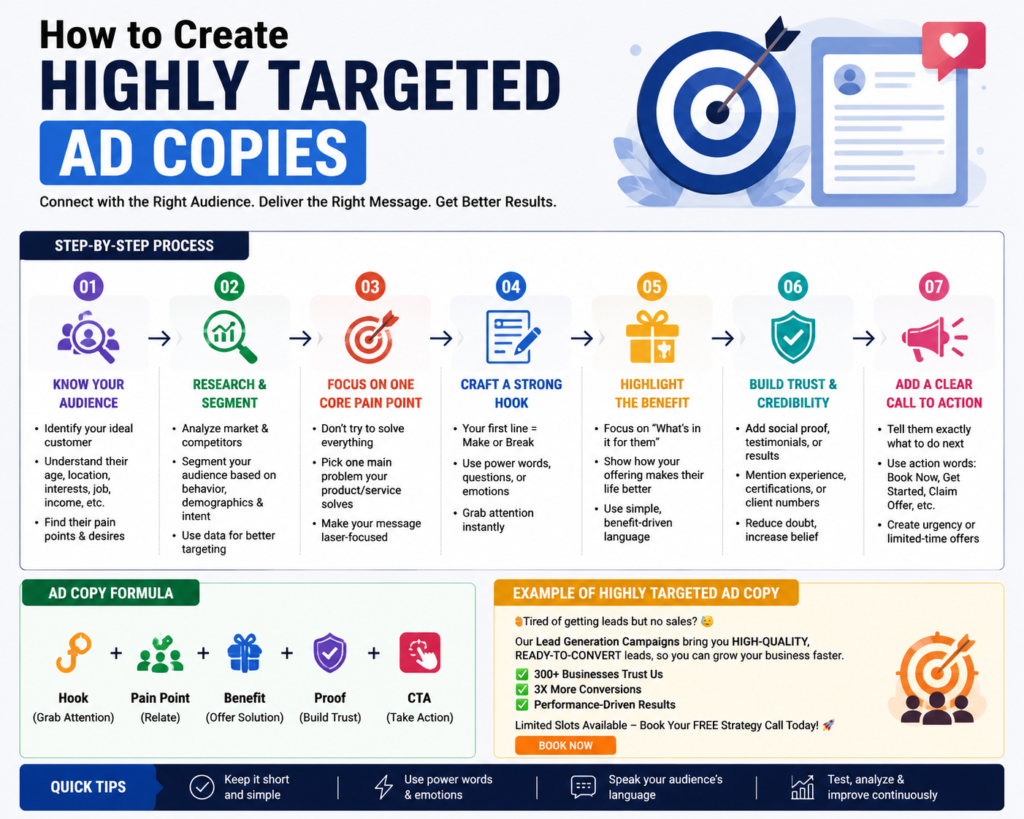
How to Create Highly Targeted Ad Copies That Drive More Clicks and Conversions
In today's competitive digital marketing landscape, creating an ad is easy, but creating a highly targeted ad copy that converts is a skill. Whether you're running campaigns on Google Ads, Facebook, Instagram, or LinkedIn, your ad copy determines whether people will ignore your ad or click on it. The best-performing advertisements don't try to sell to everyone—they speak directly to a specific audience with a clear message and compelling offer.
This guide explains how to create highly targeted ad copies that attract the right audience, improve click-through rates (CTR), reduce advertising costs, and increase conversions.
What is a Highly Targeted Ad Copy?
A highly targeted ad copy is a marketing message written for a specific audience based on their demographics, interests, behavior, pain points, and buying intent. Instead of using generic messaging, targeted ad copy speaks directly to the customer's needs and presents a solution that feels personalized.
For example, instead of saying:
A targeted version would be:
"Struggling to generate quality leads? Our performance-driven digital marketing campaigns help Delhi businesses increase qualified leads by up to 3X."
The second example immediately identifies a problem, targets a location, and presents a clear benefit.
Step 1: Understand Your Target Audience
The foundation of every successful ad copy is understanding your audience.
Before writing a single word, answer these questions:
Who is your ideal customer?
What age group do they belong to?
What is their profession?
What are their interests?
What challenges do they face?
What motivates them to buy?
What objections might they have?
The more specific your audience research is, the better your ad copy will perform.
Step 2: Identify the Customer's Pain Point
People rarely buy products simply because they exist. They buy solutions to their problems.
Your ad should clearly identify one major pain point.
Examples include:
Low website traffic
Poor lead generation
High advertising costs
Low social media engagement
Lack of online visibility
Poor conversion rates
When readers feel that you understand their problems, they are more likely to trust your solution.
Step 3: Write an Attention-Grabbing Headline
Your headline is the first thing people notice. It should immediately stop users from scrolling.
Effective headlines usually include:
A benefit
A question
Numbers
Curiosity
Urgency
Examples:
Generate More Leads Without Increasing Your Ad Budget
Want More Sales From Facebook Ads?
Grow Your Business with Performance Marketing
Get 50+ Qualified Leads Every Month
Stop Wasting Money on Low-Converting Ads
A strong headline increases your chances of getting clicks significantly.
Step 4: Focus on Benefits Instead of Features
Many advertisers make the mistake of listing features rather than benefits.
Feature:
"Complete Digital Marketing Services"
Benefit:
"Generate More Qualified Leads, Increase Sales, and Grow Your Business Faster."
Customers care about results, not technical features.
Instead of explaining what your product does, explain how it improves their life or business.
Step 5: Use Emotional Triggers
Buying decisions are influenced by emotions.
Your copy should create emotional connections using words that trigger curiosity, excitement, trust, relief, or urgency.
Examples:
Limited-Time Offer
Exclusive Access
Free Consultation
Proven ResultsTrusted by 500+ Businesses
Guaranteed Performance
Save More
Increase Revenue
Don't Miss Out
These words encourage users to take action quickly.
Step 6: Build Trust and Credibility
People are cautious about clicking ads.
Adding trust signals increases confidence.
Include elements like:
Customer testimonials
Ratings and reviews
Years of experience
Client success stories
Industry certifications
Number of satisfied customers
Awards and recognition
Example:
"Trusted by 300+ Businesses Across India."
This simple statement immediately adds credibility.
Step 7: Include a Strong Call-to-Action (CTA)
Every ad should tell users exactly what to do next.
Weak CTA:
"Learn More"
Strong CTA examples:
Book Your Free Consultation
Get Your Free Quote Today
Start Your Free Trial
Claim Your Discount Now
Download Your Free Guide
Schedule a Strategy Call
Contact Our Experts
A clear CTA removes confusion and increases conversion rates.
Step 8: Personalize Your Message
Personalized ads perform better because they feel more relevant.
Instead of writing:
"We help businesses grow."
Write:
"We help gyms generate more memberships through Facebook and Google Ads."
Or:
"We help real estate companies generate high-quality property leads."
Industry-specific messaging improves engagement significantly.
Step 9: Keep the Copy Short and Easy to Read
Most users scroll quickly.
Your ad copy should be:
Short
Clear
Simple
Easy to scan
Use:
Short paragraphs
Bullet points
Action-oriented language
Everyday words
Avoid technical jargon that your audience may not understand.
Step 10: Test Multiple Ad Variations
Never rely on a single ad copy.
Create multiple versions by changing:
Headlines
CTAs
Images
Offers
Pain points
Benefits
Run A/B tests to identify which version generates the highest CTR, lowest CPC, and best conversion rate.
Successful advertisers continuously optimize their campaigns based on data.
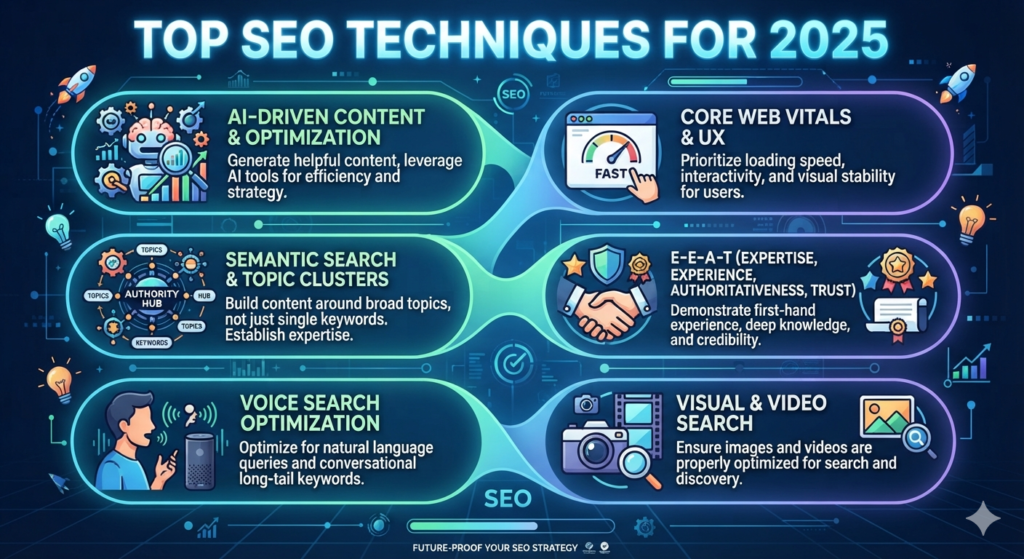
Master Guide: Top 6 SEO Techniques to Dominate Search Rankings in 2025The search engine optimization landscape is undergoing its most radical transformation in a decade. Gone are the days when keyword stuffing and basic backlink building could guarantee a spot on Google’s first page. As we move through 2025, search engines have evolved from simple query-matching systems into highly sophisticated, intent-driven answer engines.With the rise of Artificial Intelligence (AI), Generative Engine Optimization (GEO), and hyper-personalized user experiences, your digital strategy must adapt. This comprehensive guide breaks down the top six SEO techniques you need to implement right now to future-proof your rankings and drive sustainable organic traffic.
1. AI-Driven Content & Generative Engine Optimization (GEO)Artificial Intelligence is no longer just a tool for brainstorming; it is the backbone of modern search infrastructure. To succeed in 2025, creators must look beyond traditional Google algorithms and optimize for AI search assistants like Google Gemini, OpenAI Search, and Perplexity. This shift is known as Generative Engine Optimization (GEO).
The Shift Beyond Keyword MatchingAI engines do not just look for specific words. They synthesize information from multiple high-authority web pages to answer user questions directly inside the chat interface. If your content is not structured to be easily cited by these AI models, your organic visibility will plummet.
How to Implement AI-Driven SEO:Create Information-Dense Content: AI engines favor comprehensive, direct answers. Remove fluff and get straight to the point in your introductory paragraphs.Use Direct Citations and Data: Include unique statistics, original research, and expert quotes. AI models actively search for verifiable sources to cite in their responses.Incorporate AI for Content Audits: Use advanced AI tools to analyze content gaps, identify user intent patterns, and optimize readability. However, always ensure human editors refine the tone to maintain authenticity.
2. Transitioning to Semantic Search & Topic ClustersSearch engines no longer analyze keywords in isolation. Through semantic search, algorithms look at the entire context of a search query to understand the user’s true intent. Moving away from single-keyword targeting and adopting a Topic Cluster Model is mandatory for establishing topical authority.Understanding Topic ClustersA topic cluster consists of a single, comprehensive "pillar page" that covers a broad topic in depth, linked to multiple smaller "cluster pages" that address specific subtopics. [ Pillar Page: Digital Marketing Guide ]
/ | \
[ Subtopic 1: SEO ] [ Subtopic 2: PPC ] [ Subtopic 3: SMM ]
How to Build Topical Authority:Map Out Your Pillars: Identify the core categories of your business. Create long-form, highly informative pillar assets for each category.Develop Deep Subtopic Content: Write highly specific articles answering niche questions related to your pillar topic.Interlink Strategically: Use descriptive anchor text to link cluster pages back to the pillar page, and vice versa. This clear internal linking structure signals to search bots that you possess deep expertise in that specific subject matter.
3. Optimizing for Voice Search & Conversational QueriesThe proliferation of smart speakers, mobile assistants, and AI wearables has pushed voice search to an all-time high. When people speak, they use natural, conversational language rather than fragmented keywords. "Best laptop 2025" becomes "What is the best lightweight laptop for video editing under a thousand dollars?"The Nature of Conversational SEOVoice queries are typically longer, structured as full sentences, and heavily focused on local intent or immediate problem-solving. Winning at voice search requires capturing the highly coveted "Position Zero" or featured snippets.How to Optimize for Voice Search:Target Long-Tail Keywords: Focus on natural, phrasing-based terms that mirror real human speech.Implement a Dedicated FAQ Section: Structure your content around precise questions (Who, What, Where, When, Why, How) followed by immediate, explicit answers.Leverage Schema Markup: Use FAQ and Q&A schema to help search engines easily parse and pull your conversational answers for voice queries.
4. Prioritizing Core Web Vitals & Technical UXA website can have world-class content, but it will fail to rank if the user experience (UX) is frustrating. Google’s Core Web Vitals remain a critical ranking factor, penalizing slow, unresponsive, or unstable websites.Key Performance Metrics to TrackLargest Contentful Paint (LCP): Measures loading performance. Your main content should load within 2.5 seconds of the page starting to load.Interaction to Next Paint (INP): Measures page responsiveness to user inputs like clicks or taps. Aim for less than 200 milliseconds.Cumulative Layout Shift (CLS): Measures visual stability. Pages should avoid unexpected layout shifts, maintaining a score under 0.
1.How to Master Technical UX:Optimize Visual Asset Sizes: Switch to modern image formats like WebP or AVIF, and implement lazy loading for images and videos below the fold.Minimize Heavy Code: Clean up bloated CSS, minify JavaScript, and eliminate render-blocking resources.Test Mobile-First Performance: Over 60% of global search traffic originates from mobile devices. Ensure your site features seamless, adaptive layouts across all screen resolutions.
5. Elevating E-E-A-T (Experience, Expertise, Authoritativeness, Trustworthiness)As generative AI floods the internet with low-effort, automated articles, search engines are fighting back by prioritizing human-verified credibility. Google relies heavily on its E-E-A-T guidelines to filter out unreliable information, particularly in industries dealing with health, finance, or safety (YMYL - Your Money or Your Life).The Power of "First-Hand Experience"The extra "E" added to the acronym stands for Experience. Search engines actively look for proof that the content creator has real-world, hands-on experience with the topic they are discussing.How to Demonstrate E-E-A-T:Publish Detailed Author Bios: Every piece of content should be attributed to a verifiable human expert with links to their LinkedIn profile, credentials, and portfolios.Include Case Studies and Original Images: Showcase real screenshots, proprietary data charts, and video walkthroughs that prove your team executed the work.Secure High-Quality Backlinks: Build trust by earning digital PR mentions, guest spots on respected industry podcasts, and citations from authoritative educational (.edu) or governmental (.gov) domains.
6. Embracing Visual & Video Search OptimizationUser consumption habits have shifted heavily toward visual media. Platforms like YouTube, TikTok, and Instagram function as standalone search engines, while Google’s main search engine results page (SERP) increasingly embeds video grids and image packs.
Why Multi-Media Optimization MattersIf your organic footprint is restricted solely to text, you are missing out on a massive segment of your target audience. Visual SEO ensures your brand appears in Google Images, Google Lens, and video carousels.
How to Optimize Visual and Video Assets:Write Descriptive Alt Text: Do not just stuff keywords into your image files. Write accurate, contextual alt text that describes the image to both visually impaired users and search engine crawlers.Structure Videos with Chapters: Use timestamps and descriptive chapter titles in your YouTube and self-hosted videos to help Google pull relevant video segments directly into search results.Publish Video Transcripts: Provide text-based transcripts on your website to allow search crawlers to fully index the verbal content of your videos.Summary Checklist for 2025SEO PillarCore Focus StrategyGenerative AI (GEO)Dense, data-rich info structured for AI engine citations.Semantic SEOBuild topic clusters to claim complete topical authority.Voice SearchLong-tail conversational phrases and structured FAQ content.Technical UXOptimize INP, speed up LCP, and enforce absolute mobile-first design.E-E-A-TLeverage real human experience, case studies, and transparent bios.Visual SearchHigh-quality structured video chapters and contextual alt text.To win the SEO race in 2025, treat search engines as dynamic ecosystems designed to give users the fastest, most credible, and most intuitive answers possible. Implement these strategies today to secure your rankings and build resilient organic traffic.